What to Do When Markets Crash (And Why Not to Sell)
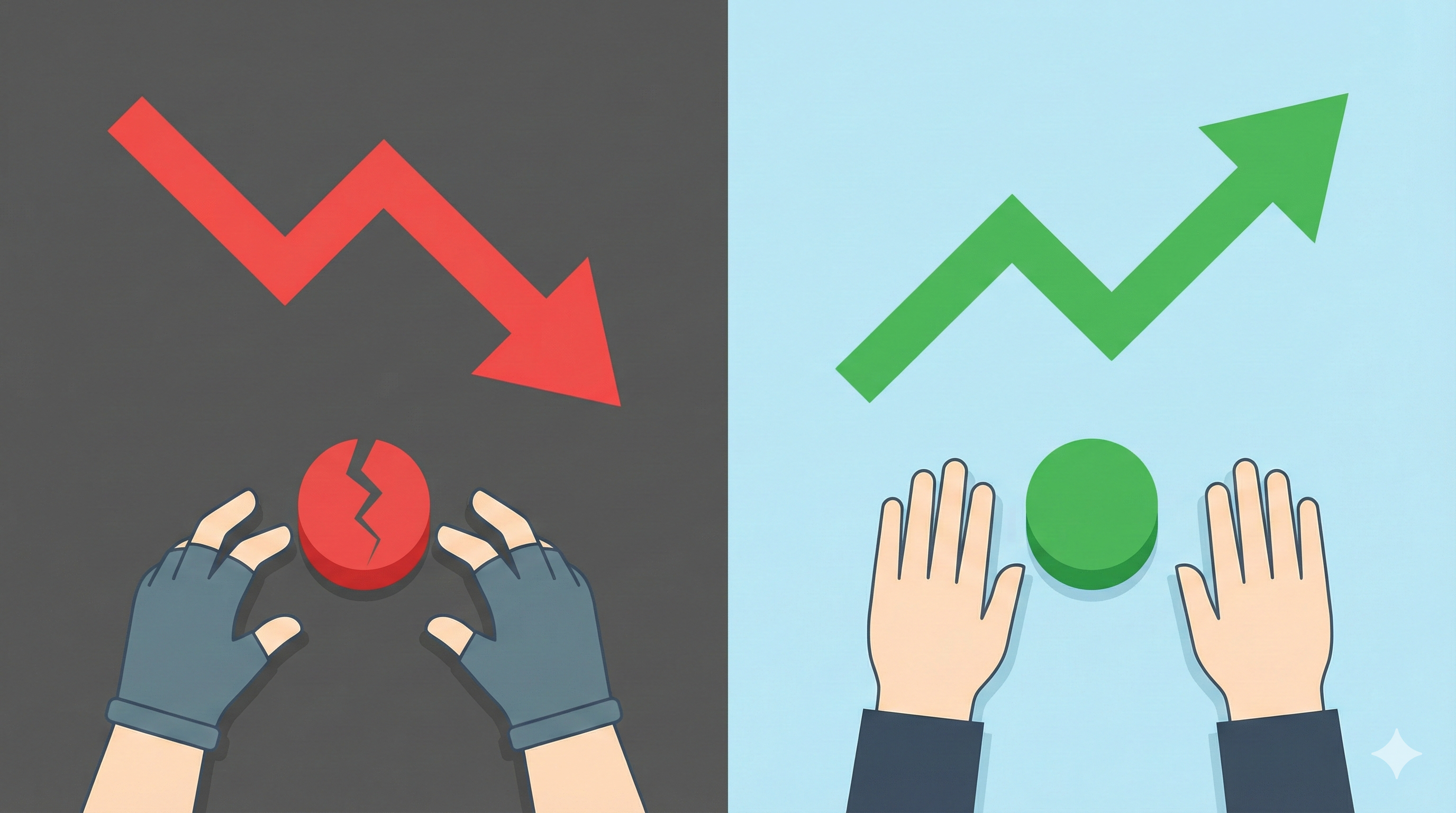
You open your app, check your investments, and see -20%. Your heart skips a beat. Your mind races:
"I need to sell before I lose everything."
Stop. This is exactly the moment when most people make the biggest financial mistake of their lives.
What Does It Mean When "Markets Crash"?
When we say the "market is crashing," we mean that stock and fund prices are falling. Investors categorize these drops by size:
| Name | Drop | What It Means |
|---|---|---|
| Dip | up to -10% | Normal, happens several times a year |
| Correction | -10% to -20% | Uncomfortable but normal |
| Bear market | -20% or more | Bigger drop, can last months |
| Crash | -30% or more, rapidly | Panic, news about the end of the world |
The important thing to understand:
All of these situations are a normal part of investing. They've always happened and always will.
How Often Do Markets Actually Fall?
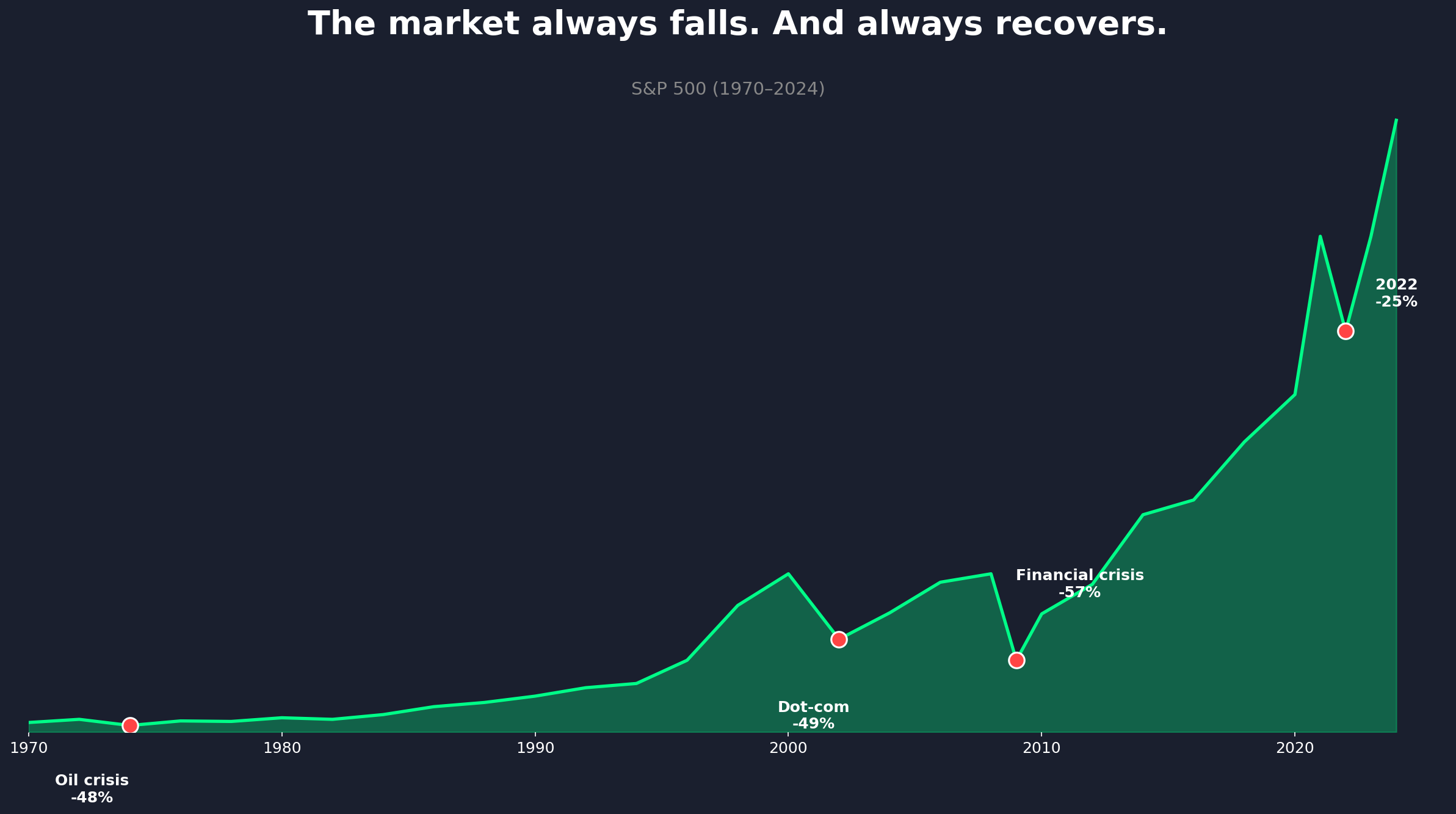
Look at that chart. Over the past 50 years, the market dropped -48%, -49%, -57%, -34%... And every single time, it recovered and grew even higher.
Drops aren't exceptions. They're a normal part of the game.
When you see -20% on your account, remember this image. The red dot is uncomfortable — but the green line always continues upward.
Why We Feel the Urge to Sell
Our Brain Doesn't Help
Evolution programmed us for survival. When you see danger, your brain triggers the "run!" response.
The problem? Your brain doesn't distinguish between a tiger and a red number in an app. It sees -25% and screams: "Save yourself! Sell!"
Losses Hurt More
Psychologists found that losing $1,000 hurts roughly twice as much as gaining $1,000 feels good. This is called loss aversion — we simply hate losing.
That's why when the market drops 20%, you feel it much more intensely than when it rises 20%. And that's why you have such a strong urge to "stop the pain."
What Happens When You Sell
Example: John and Mike
Both invested $10,000 in an ETF in January 2020. In March, COVID hit and the market dropped 34%. Both saw -$3,400.
John panicked and sold. Mike also didn't feel great, but he did nothing.
End of 2020? John has $6,600. Mike has $11,800.
Same investment, same drop. A $5,200 difference — just because of one decision.
Why Such a Big Difference?
As long as you don't sell, you haven't lost anything. That -$3,400 is just a number on the screen — it's called a paper loss. You still own the same number of shares.
The moment you sell, the paper loss becomes a real loss. The money is gone and won't come back.
Warren Buffett puts it perfectly:
"I lost half only on paper. I didn't sell anything."
What TO DO When Markets Crash
1. Nothing (Seriously)
The best strategy is often to do absolutely nothing.
If you have automatic investing set up, let it run. You're actually buying cheaper now.
2. Close the App
The less you look, the better you sleep. In turbulent times, I recommend checking your portfolio at most once a month.
3. Remember Your Plan
Are you investing for retirement 30 years away? Saving for a house in 10 years?
None of that has changed just because the market dropped this month. Your horizon is years, not days.
4. Maybe Buy More
When something goes on sale and you believe in it long-term, it's an opportunity.
Imagine an iPhone priced at $1,000. Suddenly there's a 30% discount. Do you say "great, I'll buy" or "something's wrong, I'll wait until it gets more expensive"?
With stocks, people do the second thing. Which doesn't make sense.
Conclusion
Crashes are scary. But here's the truth:
The investor's biggest enemy isn't the market crash. It's their own panic.
People who profit long-term aren't the smartest ones. They're the ones who can sit and do nothing while everyone around them is panicking.
When you see red numbers, remember:
- As long as you don't sell, you haven't lost anything
- Markets have always recovered
- Your horizon is years, not days
Then close the app and go live your life.
Have questions? Reach out at vymerd@gmail.com.
Stay Updated
Get notified when we publish new articles.
Ready to Apply This?
Start tracking your finances today and put these tips into practice.
- Import bank statements in seconds
- AI-powered categorization
- Beautiful visualizations
- Set and track financial goals
Related posts
 Learn To Invest
Trump Accounts 2026: Turn the $1,000 Baby Bonus Into $191,000 by Age 18
Trump Accounts 2026 launch July 4 with a free $1,000 seed for every U.S. newborn. The math: maxed out, $191K by age 18 and $2.2M by 60. Plus the IRS Form 4547 walkthrough, three traps, and how it compares to 529s and custodial Roths.
 Learn To Invest
Monthly Dividend Income Strategy: Build Predictable Cash Flow for FIRE in 2026
Monthly dividend income strategy builds predictable cash flow for early retirees, covering 40-60% of living expenses before Social Security while reducing sequence-of-returns risk. Three-tier approach: dividend aristocrats (60%), dividend ETFs like SCHD (25%), and high-yield specialists (15%) generate $1,600-$2,500/month on a $600K portfolio.
 Learn To Invest
HSA: The Stealth Retirement Account That Beats Your 401(k) (2026 FIRE Guide)
Your HSA isn't a healthcare account. It's the most tax-advantaged retirement vehicle in America — and the FIRE community has been quietly using it for a decade. This guide shows how the HSA's triple tax advantage beats your 401(k), how to turn it into a $446,000 stealth IRA by retirement, and exactly how to set it up in 2026.
 Learn To Invest
Mortgage vs. Investing: What's the Better Choice for You?
This article shows why the math favors investing, but the psychology quietly makes mortgages the winning move for most people. If you’ve ever wondered why “rent + invest” rarely works in real life, this might change how you think about housing forever.
 Learn To Invest
Do Stocks Always Go Up? The Truth That Will Surprise You
Same market. Same stocks. The only difference? How long you looked. See why 95% of investors who hold for 10+ years never lose money — and why those who panicked in 2020 lost hundreds of thousands.